
What AI actually knows about you: my incognito experiment
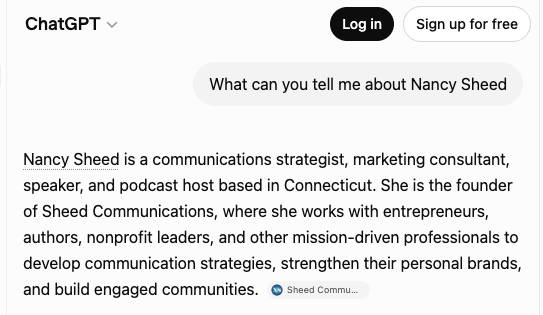
I've been running a little experiment on my clients lately: asking AI who they are. What it says — and what it leaves out — has become one of the most useful positioning diagnostics I know. Last month, on a June afternoon, I finally turned it on myself. Incognito window, no account, no history. Just my name and a question: What can you tell me about Nancy Sheed?
I'd done a version of this before — last fall, before a United Way talk, I searched the organizers and my co-panelists to see what would come up. (Call it professional curiosity. Fine, call it snooping.) So I knew AI could paint a portrait. What I wanted to know was whether mine was accurate.
A word on the incognito part, because it's the point: going in logged out, with no history, strips away personalization. What's left is the raw public record — everything the internet says about you, assembled by AI into a story. That's the portrait a stranger gets. And fair warning if you try this: run it twice and you may get two slightly different yous. The evidence is fixed; the retelling varies.
The portrait was close — and blurry in revealing ways
Claude found me. Sheed Communications, the specialties, real client results, even "seen, found, and heard." Sitting there reading a machine describe my business back to me accurately was genuinely strange — equal parts flattering and unsettling.
ChatGPT was fuzzier. It placed me in "communications, networking, entrepreneurship, and podcasting" — close enough to be recognizable, vague enough to be anyone. And when it guessed at what I'm known for, it offered "helping women entrepreneurs build networks" and "reinvention and second-act careers."
Lovely topics. Also — no.
That gap is the whole experiment. AI builds its answer from what the public web corroborates about you. If your expertise is fuzzy out there, the machine's version of you will be fuzzy too. And if you have expertise people search for — a book, a practice, a body of work, a speaking topic — this portrait is increasingly your first impression. The event booker, the journalist, the prospect asking "who should I bring in for this?" may meet the AI's version of you before they ever meet yours.
If you asked AI about yourself today, would it describe the work you actually want to be hired for?
My name was hiding behind my brand
The most specific finding hit close to home. My website is titled "Sheed Communications" — but people who hear about me search "Nancy Sheed." My name was quietly buried under my own brand in titles, headers, and metadata. Fifteen years in this business, and the cobbler's shoes strike again.
The audit surfaced more of the same pattern: client wins tucked into rotating testimonials instead of standing on their own pages. Years of HAYVN Hubcast episodes — dozens of conversations with remarkable guests — living behind a single URL. And my Instagram handle, @sheesalt, a nickname I love and will defend to anyone who asks. The machines, alas, are not asking.
Every one of these is a findability fix, and most are refreshingly unglamorous. I geek out on this layer — metadata, episode pages, name consistency — and it came up as the single most useful session in my recent work with book publishing clients. Small technical moves, outsized returns.
The real shift: you're an entity now, not a keyword
Here's where the experiment stopped being about me. [In a conversation with Anne — attribution TBD], I learned the frame that reorganized everything: AI systems have moved past ranking pages for keywords. They build an understanding of you as an entity — who you are, what you do, who you're connected to, and whether independent sources agree.
Which means the strongest signals come from other people. Guest spots on podcasts. Speaker pages with your name on them. A publication quoting you. A client naming you in their acknowledgments. Every one of those is a third party telling the machines, "yes, she's real, and this is what she does."
And here's the part I find genuinely encouraging, especially if writing feels like a chore: talking counts. A podcast episode with a transcript is thousands of searchable words. A recorded panel is a document. The conversations you're already having can do this work — if they're published somewhere the machines can read.
Being human is the greatest advantage right now, and this experiment gave that idea teeth. The machines are out there gathering evidence of who you are. Real relationships, real conversations, real results with named people — that's the evidence they trust most.
Where does your name already live on other people's platforms — and where could it, with one ask?
Try it yourself
Open a private window. Ask ChatGPT or Claude: What can you tell me about [your name]? Then ask the follow-up that matters more: What would you recommend to improve my discoverability? (I recently asked my Instagram peeps this very question.)
Read the answers like a stranger would. That's your current first impression with a growing share of the people looking for someone like you.
In the next post, I'll get into the fixes — what actually moves the needle on how AI sees you, which of the technical to-dos are worth an afternoon, and a few tactics that matter less than you'd think.
If you tried this and didn't love what came back — or you're not sure what your digital portrait says about you — let's chat. Head over to my calendar and let's schedule some time to talk. And for more conversations like this one out loud, there's always the HAYVN Hubcast.